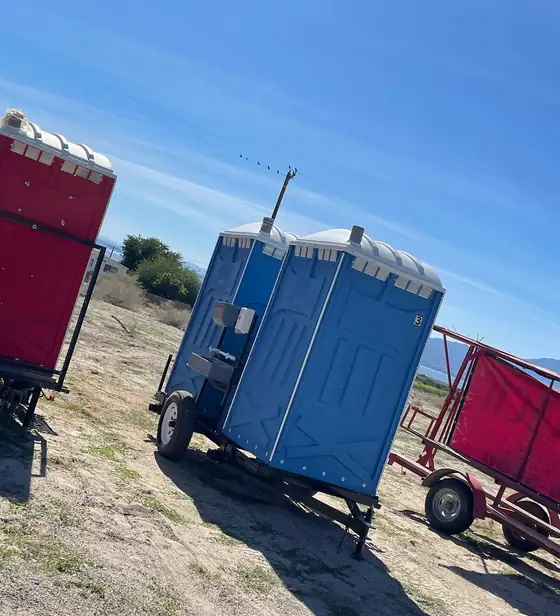
How many porta potties does OSHA require on a construction site?
OSHA rule 29 CFR 1926.51(c), Table D-1, requires 1 toilet for 20 or fewer workers. Crews of 20 or more need 1 toilet seat and 1 urinal per 40 workers. Crews of 200 or more need 1 seat and 1 urinal per 50 workers. That is the legal minimum, not a comfort target.
Table D-1 from OSHA 29 CFR 1926.51:
| Number of employees | Minimum facilities |
|---|---|
| 20 or fewer | 1 toilet |
| 20 or more | 1 toilet seat and 1 urinal per 40 workers |
| 200 or more | 1 toilet seat and 1 urinal per 50 workers |
A standard unit has 1 seat and 1 urinal. On top of the legal floor, our rule of thumb is 1 standard unit per 10 workers on a 40-hour week with weekly service. That count keeps units usable all week.
Crew-size examples
| Crew | OSHA minimum | Our recommendation, weekly service |
|---|---|---|
| 8 workers | 1 toilet | 1 unit (8 ÷ 10 = 0.8, round up to 1) |
| 15 workers | 1 toilet | 2 units (15 ÷ 10 = 1.5, round up to 2) |
| 35 workers | 1 seat + 1 urinal | 4 units (35 ÷ 10 = 3.5, round up to 4) |
| 60 workers | 2 seats + 2 urinals (60 ÷ 40 = 1.5, round up) | 6 units, or 3 with twice-weekly service |
| 220 workers | 5 seats + 5 urinals (220 ÷ 50 = 4.4, round up) | 22 units, or 11 with twice-weekly service |
Mobile crews with ready transportation to nearby toilets are exempt under 1926.51(c)(4). Units used only by construction workers also do not have to be wheelchair-accessible under the ADA. The full breakdown is in our OSHA porta potty requirements guide.
Does OSHA require hand washing stations on job sites?
OSHA rule 1926.51(f) requires washing facilities near the work when crews apply paints, coatings, herbicides or similar materials, with soap and towels supplied. One 2-sink hand-wash station holds about 350 washes. Twenty workers washing twice a day for 5 days use about 200, so 1 station with weekly service covers them.
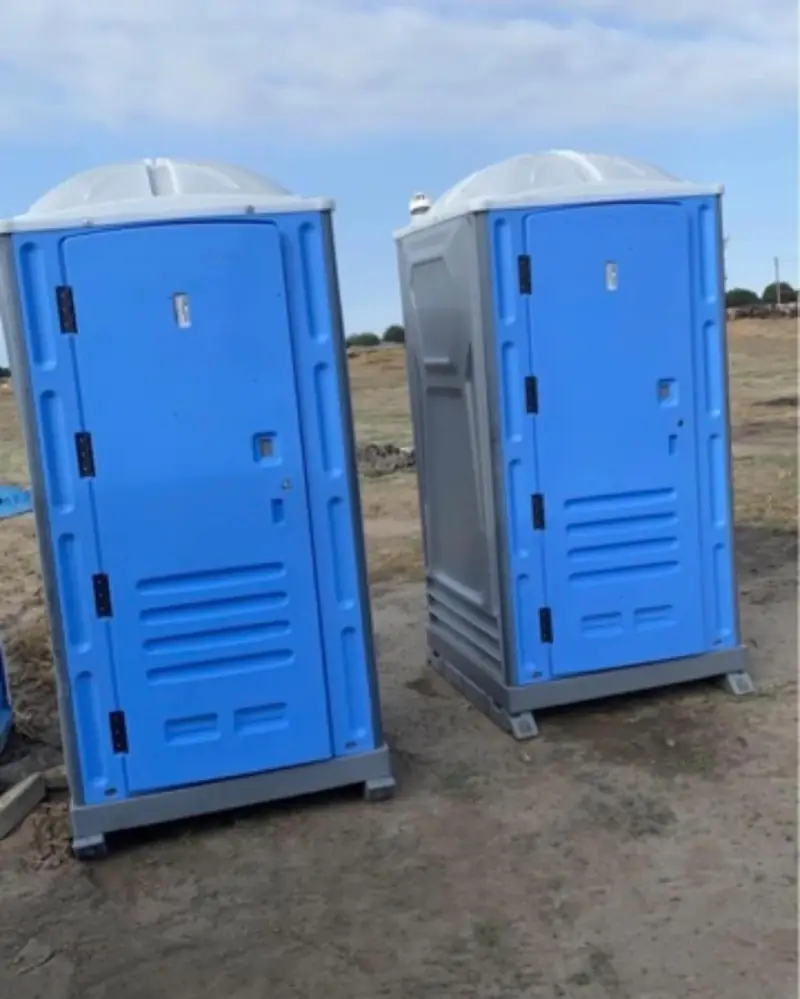
Painters, coating crews and landscapers spraying herbicide are the clearest cases. Most general contractors add a station anyway, because sanitizer does not cut through grease, mud or drywall dust.
- Up to about 20 workers: 1 hand-wash station with weekly refills.
- Larger crews: add 1 station for each extra 20 workers or so, or switch to twice-weekly service.
- Winter: fresh water can freeze from about November to March. A heated station needs a 110V outlet. Without power, sanitizer covers the cold months.
Hand-wash stations follow the same 28-day billing as the toilets, with fresh water, soap and towels at each weekly visit.
How does construction porta potty rental in Shelton, CT billing work?
Construction porta potty rental in Shelton, CT is billed per 28-day cycle, not per day. Weekly service is included in each cycle. The first cycle adds a delivery charge. After that, the rental renews every 28 days until you call or text for pickup. There is no long-term contract.
- Quote: one itemized quote lists unit, delivery and pickup, servicing and tax. No fuel surcharge and no card fee. Most quotes go out within 15 minutes during business hours.
- Booking: pay by card at booking. Businesses can ask for invoicing after the first cycle.
- Cycle 1: starts on delivery day and includes the delivery charge.
- Cycle 2 and on: renew every 28 days at the recurring rate, with weekly service.
- Pickup: call or text when the job wraps. That stops billing.
Tax-exempt groups send their certificate before the first invoice. Cancellation is free up to 48 hours before delivery. Details are on our rental terms page, and the long-term porta potty rental page walks through a full cycle calendar.
Need it delivered today?
Call before noon, Monday to Saturday, for same-day delivery.
Can one account cover multiple job sites?
One account can cover every job site you run. Each site gets its own unit list, its own 28-day cycle and its own weekly service day. Multi-site contractors get one phone number, one email for quotes and, after the first cycle, invoicing that keeps each site on a separate line.
- Separate sites, separate lines: a Shelton remodel and a Milford new build show up as two jobs, so you can bill each client.
- Distance: sites inside about 40 miles carry no extra charge. Towns 40 to 80 miles out show a distance charge on the quote.
- Adding units: when a crew grows, call to add units mid-cycle. They join the same weekly service route.
- Moving units: a move between sites is quoted before it happens.
Give the driver gate codes and lockbox details once. Nobody needs to be on site for service, as long as the unit is reachable.
Service day
Each site gets a regular weekly service day. Tell us which day the site is busiest, such as a concrete pour, so the truck stays out of the way. Twice-weekly service can be added at any site that outgrows its units.
Where should porta potties go on a job site?
Job site porta potties should sit on level, firm ground where the service truck can reach them every week. Keep units away from excavation, material drops and crane swings, and off septic covers. In windy or exposed spots, units can be anchored or staked on request.
- Truck access: the pump truck needs to park close each week. Do not box units in with dumpsters or lumber.
- Steep lots: hillside lots in White Hills and Huntington often have one flat spot on the driveway apron. Use it.
- Near the work, not in it: a short walk keeps crews on task. Keep units clear of the route for concrete and delivery trucks.
- Door direction: face doors away from the street and the neighbors.
If your current supplier misses a drop, same-day porta potty delivery is available Monday to Saturday before noon. More layout tips are in where to place a porta potty.