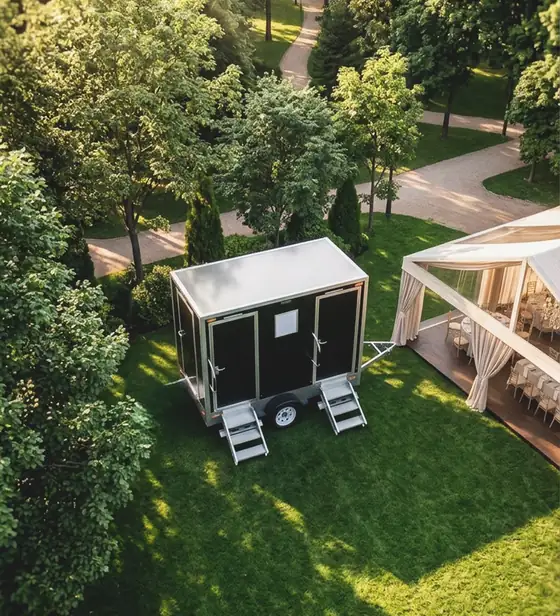
Restroom trailer, flushing unit or standard porta potty: which fits your wedding?
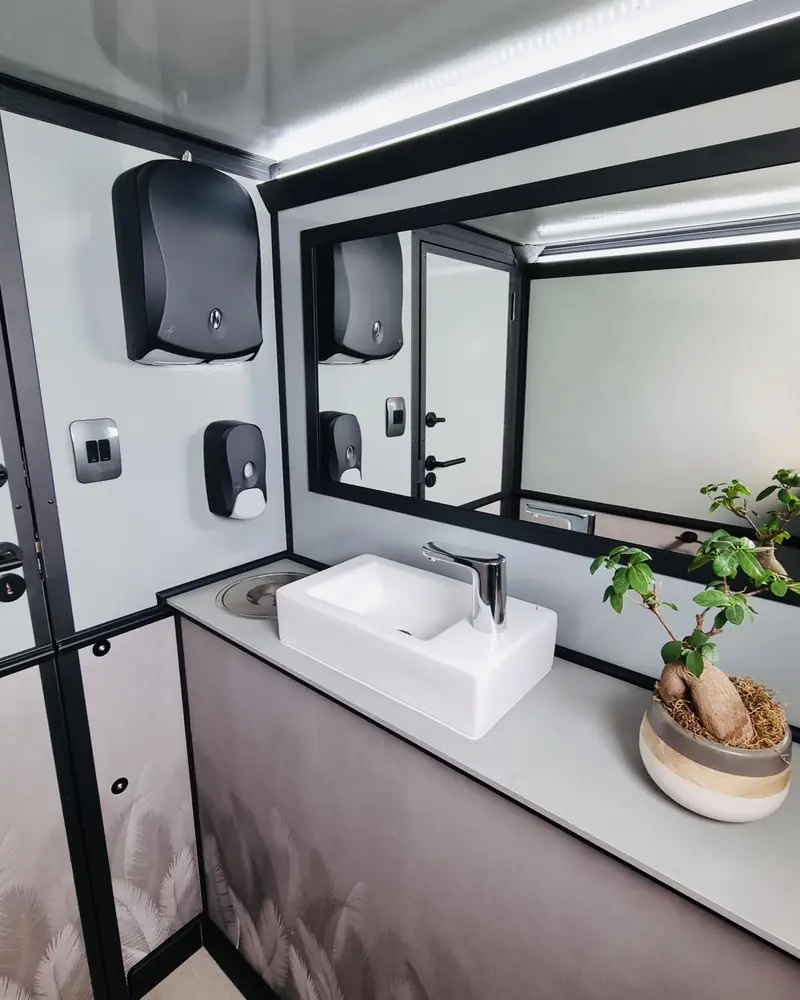
A restroom trailer gives wedding guests flushing toilets, running water, lights and climate control, but needs power, water and truck access. Deluxe flushing units add a flush and a sink with no hookups. Standard event units cost the least and fit anywhere. Many couples mix 2 types.
| Restroom trailer | Deluxe flushing unit | Standard event unit | |
|---|---|---|---|
| Guest experience | Closest to an indoor bathroom | Flush, sink, mirror in one stall | Basic, clean and stocked |
| Look in photos | Tidy exterior with steps and lights | White cabin-style shell | Classic porta potty |
| Hookups | 110V outlet and garden hose or tank | None | None |
| Space | Level spot the tow vehicle reaches | About 47 in wide; 52 in gate | About 43.5 in wide; 48 in gate |
| Budget level | Highest | Middle | Lowest |
How couples usually choose
- Formal tent wedding with power: a restroom trailer.
- Backyard wedding, no spare circuit: deluxe flushing units.
- Rustic farm or tight budget: standard event units plus hand-wash stations.
Mixing works well. A 2-stall trailer for the bridal party and older guests, plus 2 standard units near the dance floor, keeps every line short.
Ask your venue what is already on site. Some barns and estates have indoor restrooms that cover the ceremony but not a 6-hour reception.
How many restrooms for 100, 150 or 200 wedding guests?
Our sizing method uses 1 toilet per 40 guests for a 5- to 8-hour wedding, plus 1 for the bar. That works out to 4 toilets for 100 guests, 5 for 150 and 6 for 200. Add 2 hand-wash stations when food is served, and make at least 1 unit wheelchair-accessible.
| Guests | Math (1 per 40, +1 bar) | Toilets | Hand-wash stations | Trailer route |
|---|---|---|---|---|
| 100 | 100 ÷ 40 = 2.5 → 3, +1 | 4 | 2 | 4-stall trailer, or 2-stall trailer + 2 units |
| 150 | 150 ÷ 40 = 3.75 → 4, +1 | 5 | 2 | 4-stall trailer + 1 unit |
| 200 | 200 ÷ 40 = 5, +1 | 6 | 2 to 3 | 4-stall trailer + 2 units |
For the trailer route, count each trailer stall as 1 toilet. Trailer sinks cover hand washing inside, so keep at least 1 station by any standalone units.
Venue bathrooms count too. A 240-guest wedding needs 7 toilets (240 ÷ 40 = 6, plus 1 for the bar). If the venue has 2 bathrooms, rent about 5.
Add 1 wheelchair-accessible unit, since trailers have steps. More examples are in how many porta potties you need.
Cocktail hour is the rush. Most guests head for the restrooms right after the ceremony and again after dinner. Extra units shorten those lines.
For public events, ADA 213.2 sets the legal minimum for accessible units.
What does a wedding restroom trailer need for power and water?
A wedding restroom trailer needs a 110V outlet, a garden hose on a spigot or an onboard water tank, and a level, firm spot. A dedicated 20-amp circuit is recommended. Do not share the trailer's circuit with the caterer's warmers, the DJ or the tent lights, or a breaker can trip mid-reception.
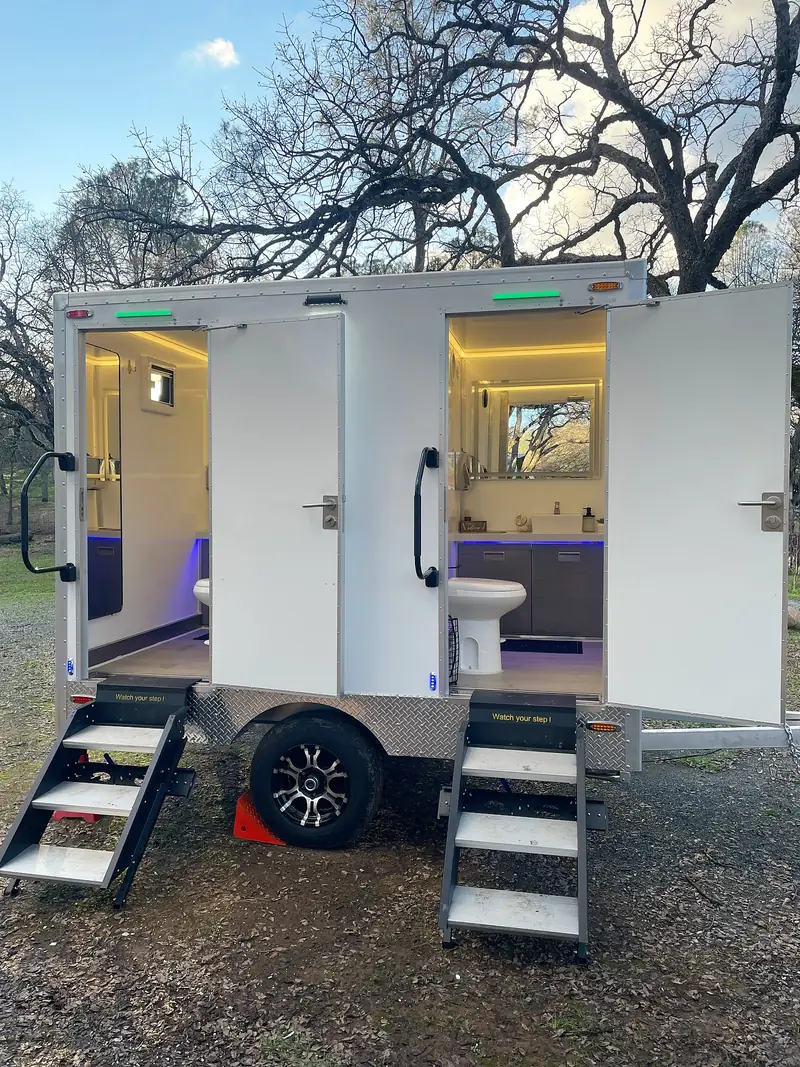
- Find the outlet early: walk the property with your planner and test the outdoor outlet.
- Check the spigot: make sure it works and a hose can reach the trailer spot.
- No spigot? Ask for a trailer with an onboard tank on your quote.
- Tent company and caterer: share the trailer's power needs so everyone plans the circuits together.
Friday delivery leaves time to level the trailer, connect power and water and test everything before the rehearsal.
Questions for your planner and tent company
- Which outlet will the trailer use, and what else is on that circuit?
- How far is the outlet from the trailer spot?
- Is the outdoor spigot on and working?
- Will the tent lights or caterer need the same outlet?
Deluxe and standard units need none of this. That is why they are the fallback at sites with no spare power.
Where should wedding restrooms go near the tent?
Wedding restrooms should sit a short, lit walk from the tent, on the side away from the dining tables and dance floor. Keep them out of the ceremony view and the main photo spots. The trailer also has to stay within reach of its outlet and spigot.
- Out of the photos: stand where the photographer will shoot the ceremony and keep the restrooms behind you.
- Lit path: string lights or path lights from the tent to the doors.
- Flat route: grandparents and guests in heels need firm, level ground.
- Accessible unit: set it on the firmest path, closest to the tent.
- Septic: at a home wedding, keep units and trucks off septic covers and leach fields.
Units can be anchored or staked on request at windy shoreline sites.
At farm and vineyard venues, ask where past couples put the restrooms. Many venues already have a spot with power and a hard surface.
Need it delivered today?
Call before noon, Monday to Saturday, for same-day delivery.
When should you book wedding restroom rental in CT?
Book wedding restroom rental in CT 1 to 2 weeks ahead for June to September Saturdays and holiday weekends. Other May to October weekends need at least 3 business days. Units drop Friday and pick up Monday, and cancellation is free up to 48 hours before delivery.
- Friday drop-off: everything is in place before the rehearsal dinner.
- Monday pickup: Tuesday after a holiday Monday. Sunday brunch is covered at no extra charge.
- Long weekends: add a mid-event service visit between the wedding and brunch.
- Planner on site: nobody needs to meet the driver if the spot is marked and reachable.
For other parties, see event porta potty rental. For timing across the year, read how far ahead to book a porta potty.
Wedding weekend timeline
| Day | What happens |
|---|---|
| Friday | Delivery, leveling and hookup test |
| Saturday | Ceremony and reception |
| Sunday | Brunch; units stay at no charge |
| Monday | Pickup (Tuesday after a holiday Monday) |
Cancellation is free up to 48 hours before delivery, so book once the guest count is close. Adjust the unit count as RSVPs come in.