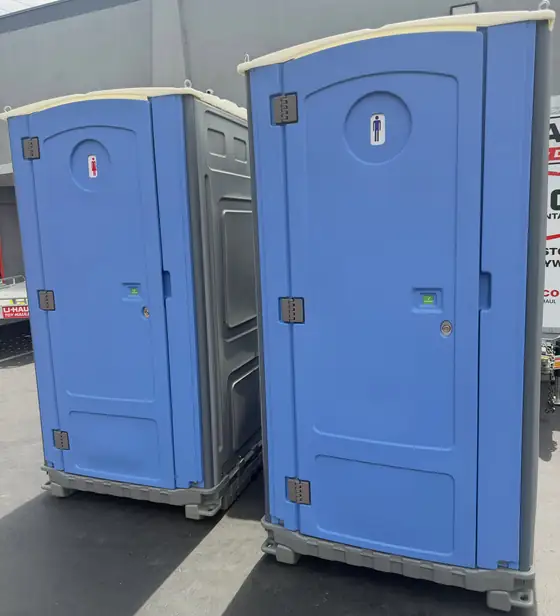
How does the 28-day billing cycle work?
The 28-day billing cycle starts on delivery day. Cycle 1 includes the delivery charge and weekly service. On day 29, cycle 2 starts on its own at the recurring rate, with no new delivery charge. Cycles keep renewing until you call or text for pickup. There is no contract.
Example calendar
| Cycle | Dates (delivered April 1) | What is billed |
|---|---|---|
| 1 | April 1 – April 28 | Rental, weekly service and delivery charge |
| 2 | April 29 – May 26 | Rental and weekly service |
| 3 | May 27 – June 23 | Rental and weekly service |
| Pickup | When you call or text | Billing stops |
- Plain math: 13 cycles fit in a year, not 12, because each cycle is 28 days.
- Stopping: call or text a few days before a cycle ends so a new one does not start.
- Payment: card at booking. Businesses can ask for invoicing after the first cycle.
- Tax-exempt: send your certificate and tax comes off.
Full terms are on the rental terms page.
Example: a marina keeps a unit from April 1 to October 13 and pays 7 cycles. Keeping it through October 31 starts an 8th cycle on October 14. For a one-weekend need, the flat event porta potty rental price is the better fit.
What happens at a weekly service visit?
A weekly service visit takes 5 steps. The driver pumps the holding tank, cleans the inside, sanitizes the seat, urinal and handles, restocks paper and sanitizer, and checks for damage. Hand-wash stations get fresh water and soap at the same visit. Nobody needs to be on site.
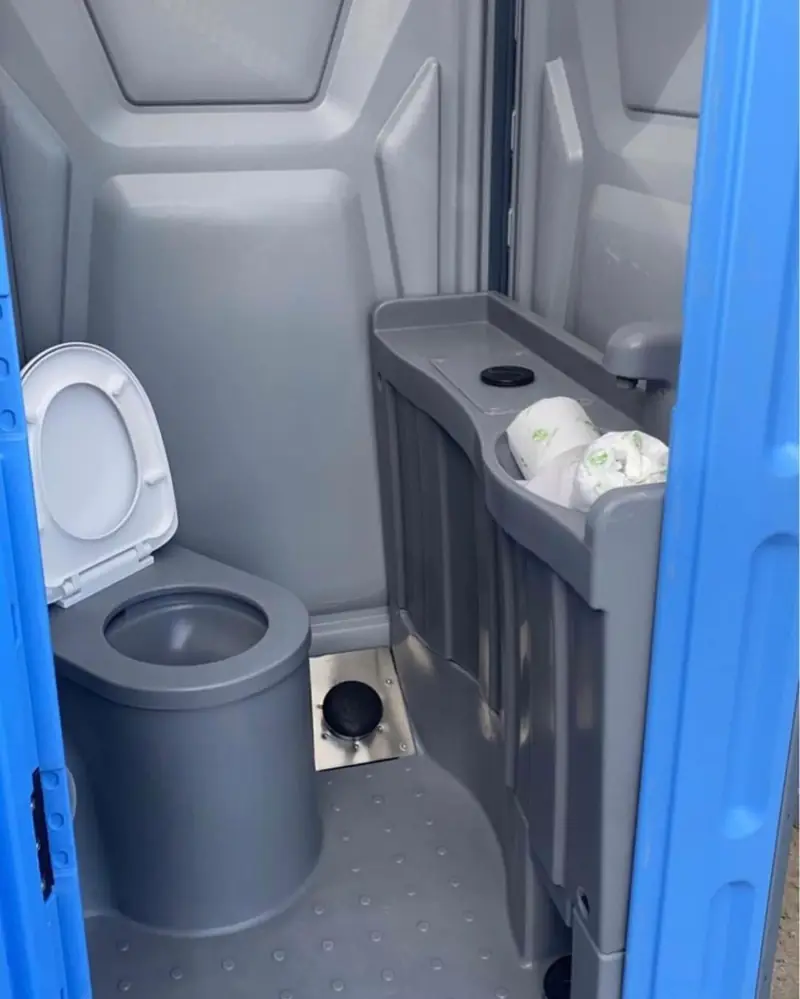
- Pump: the truck vacuums the holding tank empty.
- Clean: walls, floor and seat are scrubbed.
- Sanitize: touch points like the seat, urinal, latch and handle are sanitized.
- Restock: toilet paper and hand sanitizer are refilled.
- Check: the driver looks for damage, a stuck latch or a unit that has shifted.
One standard unit serves about 10 workers on a 40-hour week with weekly service. Busy summer parks and big crews can ask for twice-weekly service instead. Read more in how often porta potties are serviced.
Leave gate codes or lock keys on file. If a gate will be locked on service day, call ahead to move the visit.
Weekly or twice weekly?
Weekly service fits about 10 workers per standard unit on a 40-hour week. Choose twice-weekly when a unit serves more people, such as a park on summer weekends or a crew of 15 sharing one unit. The second visit is added to the quote.
Keep the door closed and the path clear on service day. A blocked or locked unit cannot be pumped.
Which sites use long-term porta potty rental in Shelton, CT?
Long-term porta potty rental in Shelton, CT fits marinas, parks, ballfields, farms, truck storage lots, churches and buildings without working bathrooms. Seasonal sites often rent from April to October. Farms with 11 or more hand laborers fall under OSHA rule 1928.110, which sets 1 toilet and 1 hand-wash station per 20 workers.
- Marinas and boat launches: spots along the Housatonic River and Lake Housatonic run spring to fall.
- Parks and ballfields: leagues and trailheads need units all season. Public clusters need at least 5 percent wheelchair-accessible units.
- Farms and orchards: under OSHA 29 CFR 1928.110, 11 or more hand laborers need 1 toilet and 1 hand-wash station per 20 workers, within a quarter-mile walk. A crew of 25 pickers needs 2 of each (25 ÷ 20 = 1.25, round up). The rule does not apply if the work, including travel, lasts 3 hours or less.
- Storage yards and buildings: a truck lot or a building with no bathroom needs a unit full time.
- Long builds: see construction porta potty rental for OSHA counts on job sites.
Seasonal units can go out in early spring, before opening day, so they are in place for the first busy weekend.
Churches and community buildings waiting on bathroom repairs, and truck lots with no plumbing, often run units for a year or more on the same terms.
Need it delivered today?
Call before noon, Monday to Saturday, for same-day delivery.
How do porta potties handle a Connecticut winter?
Porta potties stay in service all winter. From about November to March, holding tanks are winterized so they do not freeze. Shelton's average January low is about 21 degrees, so freshwater hand-wash stations can freeze. Use sanitizer or a heated station on a 110V outlet instead.
- Winterized tanks: the holding tank is treated at service so waste does not freeze solid.
- Hand washing: a heated hand-wash station needs a 110V outlet. Otherwise, sanitizer covers the cold months.
- Snow: keep a path shoveled to the door and a lane plowed for the service truck.
- Wind: units on open lots can be anchored or staked on request.
Our winter porta potty rental guide covers cold-weather setups in detail.
Units that stay through winter keep their weekly service. After a big storm, service may shift a day while roads are cleared.
Heated hand-wash stations need power from November to March. Where there is no outlet, a sanitizer dispenser in each unit carries the site until spring.
What units work best for a long-term rental?
A standard porta potty is the workhorse of long-term rental, serving about 10 users a week with weekly service. Add a wheelchair-accessible unit where the public visits, and a hand-wash station where people eat or handle food. Deluxe flushing units are less common because their water needs frequent refills.
- Standard unit: job sites, storage lots, farms and marinas. See standard porta potty specs.
- Wheelchair-accessible unit: parks, ballfields and anywhere the public uses the units.
- Hand-wash station: farms, food stands and crews working with paint or chemicals.
- Deluxe flushing unit: offices or staff areas where people want a sink in the stall.
Mixing is common. A ballfield might run 2 standard units, 1 accessible unit and 1 hand-wash station from April to October.
Gray units blend in better at parks and marinas than bright blue. Ask for a neutral color when you book.