Restroom Trailer vs Luxury Porta Potty
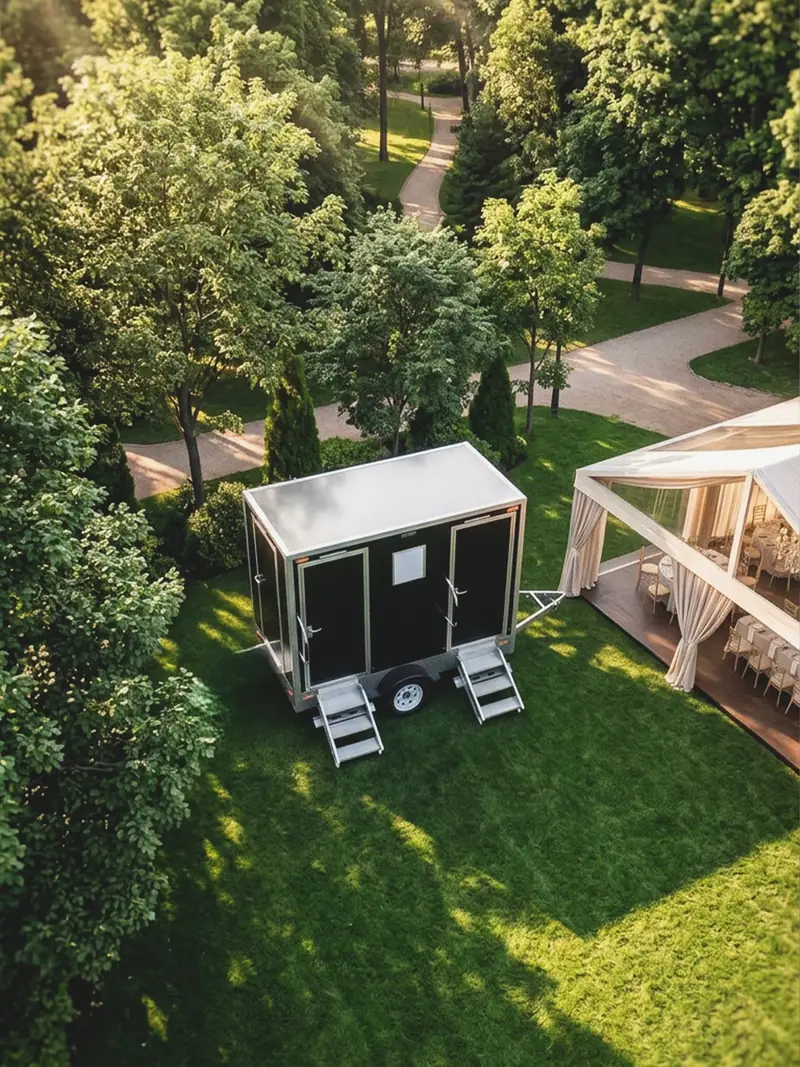
A restroom trailer is a small building on wheels with flushing toilets, running water, lights and climate control. A luxury porta potty, also called a deluxe flushing unit, is a single stall with a foot-pump flush and sink. Trailers need power and water. Deluxe units need no hookups and fit tighter spots.
Both options are a step up from a basic porta potty. The right choice depends on your guest count, your site and your budget. This side-by-side comparison helps you pick.
What is the difference between a restroom trailer and a luxury porta potty?
The main difference between a restroom trailer and a luxury porta potty is size and setup. A restroom trailer has 2 or more private stalls with real sinks, mirrors and lighting. A deluxe flushing porta potty is one stall with a foot-pump flush, a small sink, paper towels and a mirror.
| Feature | Deluxe flushing unit | Restroom trailer |
|---|---|---|
| Stalls | 1 per unit | 2 or more |
| Flush | Foot pump | Standard flushing toilets |
| Sink | Small foot-pump sink inside | Sinks with running water |
| Lights and climate control | No (daylight roof) | Yes |
| Power | None | 110V outlet, dedicated 20-amp circuit recommended |
| Water | None (onboard tank) | Garden hose or onboard tank |
| Space | About 4 x 4 ft each | Long, level spot plus room for steps |
| Typical Shelton-area quote | $325 to $475 per event | 2-stall $1,195 to $1,795; 3 to 4 stall $1,895 to $2,995 |
Prices are a typical Shelton-area quote for a weekend or 1 to 5 day event. Your itemized quote is final. See porta potty rental cost for the full price guide.
Does a restroom trailer need power and water?
A restroom trailer needs power and usually water. Plan for a standard 110V outlet, with a dedicated 20-amp circuit recommended, within reach of the trailer. The trailer also needs a garden-hose water source or an onboard tank. A deluxe flushing porta potty needs no power or water at all.
If your venue is a field, barn or beach with no outlet, a generator or deluxe units are the practical choices. Ask about power when you call so the quote matches your site.
Never run a restroom trailer on a long, thin extension cord shared with a caterer or band. A dedicated circuit keeps the lights, fans and pumps running all night.
How much space and access does each one need?
A restroom trailer needs a long, level spot and a clear path wide enough for a truck and trailer to back in. A deluxe flushing unit needs about a 4 by 4 foot spot and a gate about 52 inches wide. Steep driveways, soft lawns and tight turns favor deluxe units.
Restroom trailers have entry steps. Plan a firm, lit path to the door. For yard layout tips, read where to place a porta potty.
Need it delivered today?
Call before noon, Monday to Saturday, for same-day delivery.
How many guests can each option handle?
Guest count decides most restroom choices. For deluxe flushing units, plan 1 unit per 50 guests for events up to 4 hours. Use 1 per 40 guests for 5 to 8 hours, and add 1 if alcohol is served. Restroom trailers are matched by stall count, so share your guest list and hours.
That sizing method is our recommendation, not a law. Use the how many porta potties do I need guide to run your numbers.
- 50 guests, 4 hours, no alcohol: 1 deluxe unit.
- 100 guests, 4 hours, with alcohol: 3 deluxe units.
- 150 guests, 6 hours, with alcohol: 5 deluxe units, or a restroom trailer sized by quote.
Which is better for a wedding?
A restroom trailer is better for a wedding when you have power, water and a level spot. Guests get a real bathroom with lights and climate control. Deluxe flushing units are better for remote sites, tight yards and smaller budgets. June to September wedding Saturdays book up 1 to 2 weeks ahead.
Many couples pair a trailer with a few standard units near the dance floor. See wedding restroom rental and restroom trailer rental for setups.
Do you still need a wheelchair-accessible unit?
A wheelchair-accessible unit is still needed in most cases, because restroom trailers have steps at the door. Add at least 1 ground-level wheelchair-accessible unit near the trailer. The ADA 2010 Standards, section 213.2, call for at least 5% of clustered portable units to be accessible.
Read the ADA 213.2 text and see our wheelchair-accessible porta potty rental.